Introduction
Capture browser traffic and turn it into a production-ready typed API client.
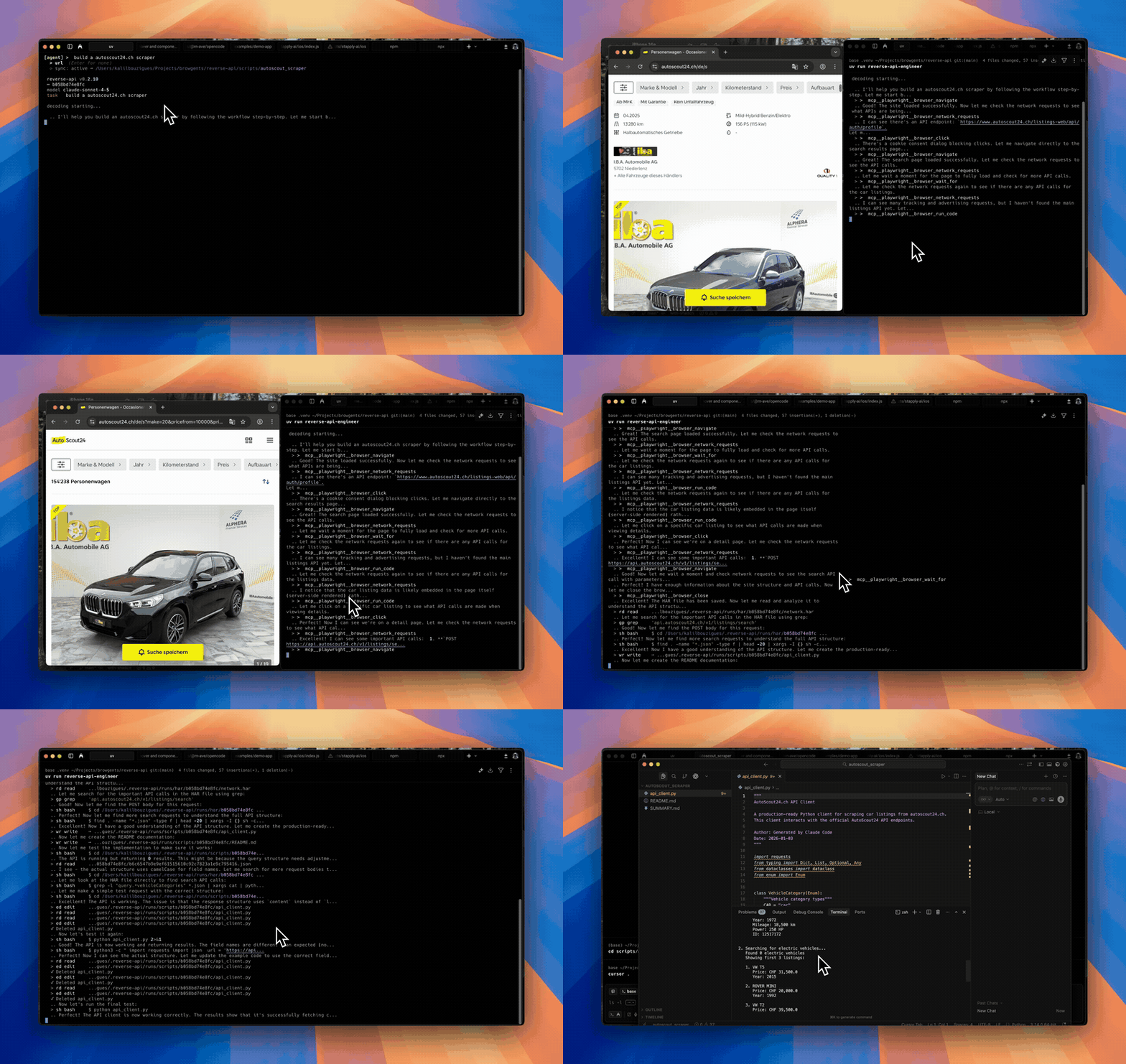
Reverse API Engineer is a CLI tool that captures browser traffic and uses your configured AI SDK to generate production-ready API clients in Python, JavaScript, TypeScript, Go, Java, C#, PHP, Ruby, or C. No more manual reverse engineering: browse, capture, and get clean API code.
Get the CLI running in under a minute.
From install to a working API client.
Agent, Manual, Engineer, Collector.
Models, providers, SDKs, output.
What you can do with it
Reverse-engineer any HTTP-based API
Job boards, e-commerce, SaaS dashboards, social platforms, internal admin tools: if it's a website that talks to a backend, Reverse API Engineer can map that backend for you. The generated client wraps the same endpoints your browser called, with auth, pagination, and error handling already wired up.
Where it fits
Use it when the browser already knows the workflow, but the API is undocumented or too time-consuming to map by hand:
- Job boards: capture search, filters, pagination, and detail endpoints.
- E-commerce sites: turn listing and product requests into reusable client methods.
- Authenticated dashboards: use manual capture or Chrome DevTools MCP when cookies and existing sessions matter.
- Internal tools: document backend calls before replacing brittle UI automation.
- Agent workflows: run captures from another agent and consume the JSON result programmatically.
Drive captures from another agent
Scripted commands are available for agent workflows. agent, engineer, and
run support JSON output plus non-interactive execution, agent, engineer,
and run can stream NDJSON progress with --json-stream, and list plus
show support JSON history inspection. Easy to wrap in a CI job, a
Claude Agent SDK loop, or a cron task.
Feature deep-dive
Browser automation with stealth
Manual mode drives a local Playwright browser (optional [manual] extra)
with anti-detection patches and viewport randomisation, recording every request
as a HAR file — headers, cookies, request bodies, response bodies, timing. Agent
mode captures the same detail autonomously (see below); the Playwright MCP and
agent-browser providers also produce a HAR, while Chrome DevTools MCP reads
network traffic directly through its MCP tools.
Autonomous agent loop
Plug an agent into the loop and it browses on your behalf. Three providers ship today:
- Playwright MCP (default): self-contained browser automation; add
--headlessfor CI or machines without a display. - Chrome DevTools MCP: drives your real Chrome with existing sessions, cookies, and auth.
- agent-browser: delegates browsing to the Vercel
agent-browserCLI after resolving a PATH/global/npm/npx shell invocation.
The agent reverse-engineers the API in real time while it browses, so by the time the run ends, the client is already generated.
AI-powered codegen
The HAR is fed to your configured SDK model (Claude by default) along with a tuned system prompt. Output:
- Typed clients with language-appropriate documentation.
- Authentication handling: cookies, bearers, CSRF tokens.
- Pagination helpers, error types, retry-safe operations.
- A runnable
example_usage.*and a generatedREADME.md.
Multi-SDK: Claude, OpenCode, Copilot, or Cursor
Use Anthropic's API directly (default) or route through OpenCode running locally. Copilot and Cursor SDK backends are also available when their optional dependencies and credentials are configured.
Interactive CLI with mode cycling
Press Shift+Tab to cycle between modes. Slash commands (/settings,
/history, /messages) keep configuration and run inspection one keystroke
away.
Session history & cost tracking
Every run is saved to ~/.reverse-api/runs/. View past captures, generated
scripts, and full message logs. Token usage and cost are tracked per run with
cache-hit awareness, useful when iterating with engineer mode on the same
HAR.
Production-ready output
Generated scripts include type hints, structured error handling, and inline documentation. They're not "demo" snippets; they're meant to be checked into your codebase and called from production.
Output in nine languages
Switch between Python, JavaScript, TypeScript, Go, Java, C#, PHP, Ruby, and C
in /settings. Same capture, different code. Useful when you want the same API
client surfaced to multiple stacks.
Limitations
License
MIT. See LICENSE.